Medellín’s Comuna 13 Neighborhood: Global Tourist Destination Despite Violent Past
In 2002 – 24 years ago – Medellín’s San Javier (Comuna 13) neighborhood was a center of extorsion, kidnapping, murders and narco turf wars run by pseudo-communist gangsters including FARC, ELN and the “People’s Armed Commandos,” as well as pseudo-right-wing paramilitaries.
Caught in the middle of this nightmare were tens of thousands of Colombia’s poorest people — many of whom had desperately emigrated to Medellín’s Comuna 13, hoping (ironically, as it turned out) to escape decades of violence and poverty in the countryside.
But starting in October 2002, dramatic changes began — mainly as a result of the “Operation Orion” military takeover of Medellín’s Comuna 13 (San Javier).
According to Operación Orion statistics as reported by local non-governmental organization Corporación Jurídica Libertad, “80 civilians were wounded, 17 were killed by the armed forces, 71 people were murdered by paramilitaries (AUC), 12 people were tortured, 92 disappeared, and 370 were detained” during the two-and-a-half-day operation – figures disputed by various families in Comuna 13 as under-estimated.
But ever since Operation Orion – and despite continuing claims and counter-claims over the Colombian military’s alleged excessive violence, its alleged arbitrariness, its accidental killings of ordinary local civilians, alleged right-wing political bias, and its actual long-term efficacy — Comuna 13 has gradually undergone a dramatic change for the better.
The city of Medellin’s pioneering, transformative construction of free electric esclators through the steep hillsides of Comuna 13 – starting in 2011 during the Mayorship of Alonso Salazar and their official inauguration in 2012 during the Mayorship of Aníbal Gaviria — represented another crucial step forward.
Since then, Comuna 13 has grown to become an incredibly popular tourist destination – with visitors numbering tens of thousands daily during peak seasons such as Medellin’s annual Feria de las Flores in August and the December year-end holidays that feature amazing, sculptured light shows alongside Rio Medellín.
Today, curious visitors can go to the city of Medellin’s official tourist web site (https://www.medellin.travel/comuna-13-3/) for information on how to tour through Comuna 13.
“To take a tour in Comuna 13 of Medellín, take the Metro to San Javier station (Line B), where you’ll find local guides, identified by their T-shirts or umbrellas (often blue or green), offering group or ‘free-tour’ trips to the escalators and the [actually misnamed] ‘Graffiti Tour.’ It’s recommended to book with local agencies via WhatsApp or platforms like Civitatis to take the tour with local guides to learn about the area’s transformative history,” as explained by the official tour agency.
However — if you are Spanish fluent – then it’s also possible to arrange a private tour with a local, official guide, as I did this week with the delightful local resident Gloria (cell: 322-888-0403), along with my wife and brother-in-law, both long-time Medellin natives.
Before this tour, all three of us had already known the history of Comuna 13, and understood the painful roots to Medellin’s (and Colombia’s) past.
So for decades, we had avoided taking this tour, in part because of its presumed simplicity — electric outdoor escalators, what’s the big deal? — and a presumably banal, juvenile graffiti parade.
What’s more, we had little interest in jostling among hordes of foreign backpackers and travel-stamp collectors making what has recently become a “chic” ticket-punch for Medellin bragadocchio.
Fortunately, thanks to our advance planning, Gloria took us on a three-hour walking tour that didn’t start at the usual entry-point, and instead had us slinking through dense, steep, narrow back-passages – and witnessing a spectacular break-dancing group performance inside a hidden, open square off the main tourist trek.
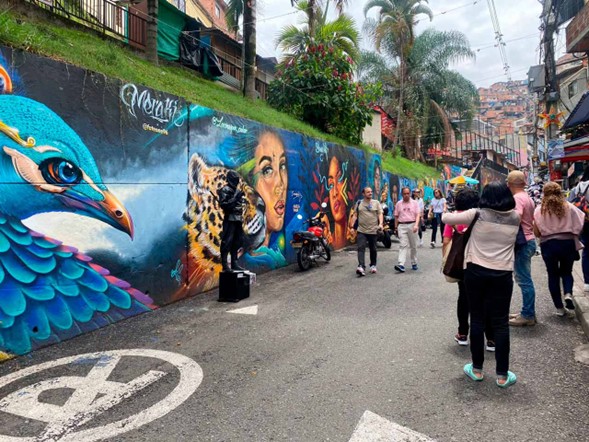
Our tour also included visits inside many artista shops featuring paintings that might have inspirational roots in cement-wall “graffiti,” but now much more sophisticated, and more like the novel wall paintings along the main tour walkways (see above, official city of Medellin photo).
We also made stops to visit what turned out to be rather gimmicky shows either requiring 3D glasses, serpentine passages with costumed artists, or cell-phone-photo-shot platforms pitching goofy selfie scenes, overlooks, drone shots or Disney-like illusions. Some entertaining — but others I would rank as least-favorites.
So be advised: Tacky tourist T-shirts, trinkets, gimmicky shows, excessively loud boom-boxes, cheap artefacts and hum-drum food-and-drink stands are numerous and ubiquitous along the main tourist route.
However: In fairness, these businesses (tacky and otherwise) are crucial to the economic transformation of San Javier, a neighborhood where some relatively tiny houses that during the bad years sold for as little as a few hundred dollars can now sell for more than US$100,000 — thanks to the surge in income from tourists, as our guide explained.
It’s that jarring combination of tackiness, wondrousness, painfulness, mystery, history, joyousness and colorfulness – alongside hucksterism, soft-selling, kindnesses, laughter and sincerity — that provoke a jumble of feelings when touring through San Javier.
But at the end of a surprising (and admittedly tiring) three-hour climb through part of Comuna 13 this week — with our wonderful guide Gloria, sharing joyous smiles and laughter from her local friends along the route — the three of us began squaring the current experience in contrast to our previous, incomplete and admittedly biased, historic impressions.
All that while resting on little chairs, gazing at a panorama overlooking mainly northern Medellín and its more-modest, popular, blue-collar neighborhoods.
So if you plan an honest visit to San Javier – not a superficial “graffiti tour” — then first do some history homework, and hire a local guide.
That’s a start to understand Medellin, but only a start.
An honest journey will be both painful and wondrous, banal and beautiful, horrendous and pacific, poor and rich.
Like Comuna 13.
Like Medellín itself.